Wednesday, December 14, 2011

Alpaca Fetuses and Death Road

La Paz is a big city. As we entered on the bus from Copacabana, we were actually laughing out loud at how chaotic it was--people running through busy streets holding (probably nursing) babies, incessant honking, whole families on motorcycles with no helmets, and seemingly no traffic laws whatsoever. We took some footage, which we are saving for the special feature video we intend to make when we get back to San Francisco...

I've never seen a man so happy about shoes before I went to La Paz!

This woman was selling something mysterious out of a cardboard box-- and she was actually sitting inside the box! Also, check out the way they sell pantyhose here. And I know this is weird, but for some reason, the person on the right reminds me of the Chinese character in Tracey Takes On ... I hadn't thought about that show in years until I really analyzed this photo.

This is a public bus in La Paz. I think this might be the coolest thing about the city ... they come in an assortment of colors.

You need one of these gas masks to breathe here without a safety hazard. So far, I haven't actually seen anyone wearing one though.

Candid shot of the officers guarding the bank who didn't want me to take their photo. Unfortunately, you can't see the huge rifle he is wielding (in addition to the couple handguns). They also have a special holster for a huge can of tear gas attached to their chests.

I can't get over how well-manicured that traffic island is...

The wizard can unlock your car doors.

At the Witch's Market ... a dead alpaca fetus hanging in front of a bunch of erotic films?

More fetuses, which are used in rituals to please Patchamama (Mother Earth).

I like this guy's face.

At the Musical Instrument Museum, a wonderful collection of instruments from Bolivia and beyond.

One of my favorites: This armadillo is not out of place, they actually used its hollow body to reverberate sound--it was transformed into a charango. They also used the bodies of tortoises.

At the full moon party at our hostel in La Paz, we made friends with the two girls on the right and actually met up with them at our next destination: Coroico.
We are wild and crazy girls, so we decided to bike Death Road! In 1995, the Inter-American Development Bank christened it as "the world's most dangerous road." Boy, what a struggle it was...

View of La Paz on our way to the start of the road.

The first part of the biking trip was pure magic. The scenery was amazing and the road was paved, with a nice amount of curves to keep things interesting. If only the entire road was as pleasurable as this.

Our group: Monica on the left, a French couple in the middle, two Mexican guys on the right, one videographer (from the biking company) and one guide.

Our safety van, rolling through fog.

This is a famous shot of the deadly drop down the cliff.

Waterfall? More like waterwall.

The road was peppered with memorials to people who've lost their lives here. I tried not to get too distracted by them.

A cross on the left and a lush mountain in the background.

Our guide demonstrating how to ride a bike. No, I'm kidding, I don't know what he was doing here.
So basically the ride was kinda hell for both Monica and me, for different reasons. It was definitely off-roading to the extreme because of two factors: Huge rocks and 80% downhill. We had mountain bikes with shocks and great brakes, but the shocks really didn't seem to cut down on the vibrations that much, which leads me to the reason the ride was hell for me, personally. The vibrations made me itch so bad I wanted to tear my skin off! Seriously it started in my hands and feet and worked its way up my arms and legs and throughout my entire body, including my forehead. If I had died on that trip, it would have been because I kept having to reach one hand up and scratch my face while going downhill 40 mph. I'm not kidding. And no one else was having that problem, nor had anyone else ever had that problem according to our guide. I've had itching problems before, due to exercising in cold weather, and this was comparable to that, but one million times worse because it encapsulated my entire being. At one point, I really didn't think I could make it any farther and I wanted to quit, but for some reason I didn't. I would never do this again, even if I were paid a fatty bankroll. Monica fell twice, the second time being pretty bad (but she's okay of course), so that's why the ride was shitty for her. I'll let her tell you more about her experience if she wants.

The videographer was there only to take photos and videos of us all as we biked down the road. We have the CDs with us, but unfortunately our laptops don't have a disc drive, so we have to wait until we find a computer that does before we can show off those badass photos...

At the end of the trip, we ate a buffet lunch at a hotel with a pool.

It looks nicer than it was. We didn't go in the pool. Instead we sat next to the blaring Top 40's tunes. I absolutely hate that song "I've Got A Feeling ... That Tonight's Gonna Be A Good Night"--worst song ever and we hear it all over the place. Turns out there were a million flying bugs that resembled gnats but that bite as bad or worse than mosquitos. I got tore up!
We then took a local van from Yolosa (town at the end of Death Road) to a small town called Coroico, which I'll write about in my next blog post.

What we ate in Bolivia

Food in Bolivia is not much different from food in Peru, sporting the same staples: potatoes, corn, bread, deep fried everything. I was hoping this trip would help me lose weight, by being active and outdoors all the time, but given that I've eaten the weight of a whale in french fries and fried chicken, fish, etc. I'm starting to lose faith in the concept of "travel fitness." Traveler's diet is one of carbs, deep fried stuff and more carbs - at least in South America.

Lots of good veggies don't grow at higher altitudes or they're not very popular I guess. Walking around markets you always see half rotten, semi-dried up, overripe or extremely blemished veggies. Tried to make some pasta the other day and had a hard time finding 2 bell peppers that were not scorched up and a bit rotten, tomatoes in the same pathetic shape. The only things that seem to keep well are onions and garlic. If you're a chef, or love crisp, fresh, crunchy vegetables, the markets here can be very disappointing in their offer. I should also add the lack of variety. The only veggies you can buy are: potatoes, tomatoes, onions, spicy peppers, giant squash sold by the slice, and that's it. Think about this next time you go to your local produce market. You (we) are lucky bastards.

Another reason why we've been eating so many carbs is that meat is often unsafe here. Having to choose between a boring safe meal and risking explosive diarrhea, we often go with the safe meal. We do eat meat, but only from places that seem to have some sort of idea of sanitary conditions. The meat in markets is hanging out in the doorstep, never refrigerated, sometimes a dog or a cat chills out right next to a slab of meat, flies sit on it freely, people walk by and touch it, cars drive by and cover it in their smog. Not to mention the stench of meat sitting outside for hours. Seeing this with our own eyes, we are very cautious what we eat and never eat meat sandwiches from street vendors. So far, we've been really lucky and never got sick.

In the photo below, I made pasta with tomato sauce and sauteed vegetables and we ate it on our own private patio at the hostel Las Olas in Copacabana. Paired with a cold Bolivian brew, some soft music from Anne's laptop and this magic sunset, our quaint dinner was a success, despite the over-boiled pasta.

Below: Panetone ladies in La Paz. Since it's almost Christmas time, Panetone is all the rage both in Bolivia and Peru. Millions of different types of Panetone are being sold all over the streets of La Paz. 


The streets of La Paz are like a big supermarket. People set up shop in the middle of the street, literally. You can buy anything you want. We even saw a guy with a megaphone, yelling out loud that he's selling 2 string panties for the price of one. It also seems that each street specializes in selling a specific type of product. On one street there's fruit, on another street you can buy meat and fish, on yet another one there are colorful chola skirts for sale, then you move on to the street selling snacks, like the ones pictured below. The small baggies cost 1 Boliviano (there are 7 Bolivianos for 1 USD) or you can buy "wholesale." My favorite snacks were the dried/fried (?) banana slices and the salty roasted Lima beans. YUM!


In the image below you can see a variety of dried spicy peppers. The food you can buy here publicly is not very spicy, but I've heard of a lot of traditional dishes they only make at home and never sell in restaurants. I wish I could try some of those, but unfortunately we didn't have the opportunity. 


Condiments store in La Paz


Luna Llena (full moon) - vegetarian dish at the hostel Sol y Luna in Coroico. Coroico is a small village in the jungle about 3.5h north of La Paz. We stayed there for 3 days at a lodge perched up at the top of the mountain. The lodge was about 30 minutes walk up the hill from the village, and since it rained most of the time, we were forced to eat at the lodge restaurant most of the time. The food was good, portions were generous and prices quite cheap. The dish below cost about $5. It consists of a bed of rice, topped with sauteed vegetables, deep friend plantains, slices of papaya and a hard boiled egg. DELISH!


Here we are with our awesome friends Kathrine and Elizabeth from Kansas City, whom we met at the hostel in La Paz and later hung out with for a few days in Coroico at the Sol y Luna hostel. We all ordered the Luna Llena.


blah Bolivian wine is not well known, but it's quite flavorful and enjoyable. I am actually drinking a glass of it as I type this. It boasts itself as "vino de altura" (altitude wine), because the grapes grow at almost 2,000 meters. Supposedly, it's the "highest" wine in the world.


Deep fried chicken and rice at 8am on the side of the road at almost 4,000 meters! This is the morning when we rode bicycles on the "World's Most Dangerous Road." We weren't really hungry, but the van stopped for snacks in a area where a dozen women were selling deep fried chicken on the side of the road. The smell of hot fried meat was irresistible, so we decided to buy some. This picture shows the lady as she was preparing us a plastic bag filled with cooked white rice and 2 pieces of chicken on top. 


I don't remember what this thing was called, but it was quite delicious. It was potatoes, filled with either a sweet meat mix, or veggies, or rice, or some other stuff, then deep fried. Bought it on the street for 3 Bolivianos. 


Breakfast at La Cupula in Copacabana. For 28 Bolivianos (~4 USD) you'd get a coffee, a fresh squeezed juice, home-made bread, omelet, butter, marmalade and a bowl of muesli with fresh fruit. We ate this thing every day we stayed there. Best bang for our bucks, hands down. 


To get from Copacabana to mainland Bolivia, you have to take a bus, then get off the bus, get on a shitty little wooden boat with everyone else on the bus while your bus and luggage gets on a tiny wooden "ferry" and cross a body of water that is part of lake Titicaca. Since the human boat makes it on the other side before the wooden ferry carrying the bus, all you have to do is wait around or eat deep fried little fish sold by women in the market. Again, I don't know the name of these fish in English, but they were crunchy, salty and delicious. 


Ate the whole basket and was in heaven. Did I mention that I love fried fish? 


Tons and tons of bananas on the streets of Coroico. I never knew bananas grow in such big bunches and they are actually quite heavy to lift. 


Believe it or not, lots of Germans emigrated to Bolivia and it's been quite a great surprise for us to find a German bakery in the middle of the Bolivian jungle, selling rich German pastries and cakes, spezle, Braten, Christmas Stollen and other yummy things. I'm having a slice of butter cake with marzipan filling and Anne is having chocolate cake with almonds. We were in heaven, but the reality is we couldn't finish those massive slices of sugary goodness.


This lady was selling all sorts of nuts (walnuts, Brazil nuts, peanuts, etc.) covered in this thick soft white layer of sugar. She kindly offered one piece for us to try. We did, and there was SO MUCH SUGAR that I had to spit out the white portion. Anne spit hers too. We were obviously not gonna buy that crazy sugar overload (Peruvians and Bolivians seem obsessed with over-sweetening their beverages and food) so then the lady started yelling at us that we shouldn't have bothered her if we weren't going to buy anything.
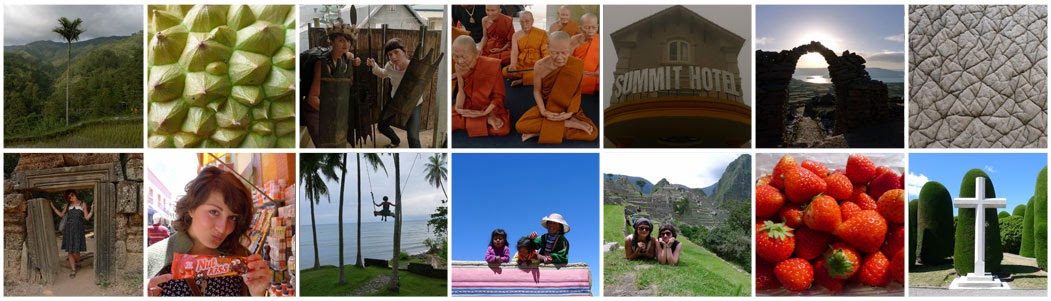
I Miss Copacabana

Copacabana deserves one more blog post. I miss this little cool place, away from everything. I'm writing now from the hostel in La Paz, listening to cars whizzing by, honking horns and splashing up water with their wheels. The city is drenched as it's been raining all day, but even the heavy, wet air cannot get rid of the thick smog that engulfs the city streets. It's been interesting getting to know this city and feeling more and more comfortable here (mostly crossing the street), but I can't say I'll be too sad to see it go. Tomorrow, Monica and I head for Buenos Aires.

In Copacabana: The hole in the rock at La Horca del Inca, an ancient astronomical observatory. Despite its name, it was actually built by the Chiripa people (pre-Inca). On the summer solstice (June 21), a sun beam passes through this hole onto ... (wait for it)

... these two rocks on the left. I'm not sure the exact logistics of it, as there was no one collecting money at the ticket booth, nor any information pamphlets to be had. After doing very minor online research, it seems there used to be many more upright rocks (like the ones on the left), but the Spanish destroyed them while searching for gold.

Self-portrait at the top (Monica didn't come up with me), Copacabana in the background.

Our amazing hostel, Las Olas. Note the enormous round bed and guitar!

One more view of Copacabana. We were encouraged to pick ourselves flowers to have in our room, which we did of course.


Friday, December 9, 2011

Peruvian Food

"...oh for a life of sensations rather than of thoughts!" - John Keats

Food is a core component of life. It gives us energy, it gathers us around a table and makes us social. We didn't consciously plan to take photos of all the food we ate or encountered so far, so this post was more of an after-thought, using the photos we had that matched the food theme. 


Food in Peru can be either very tasty or very flavorless, depending on where you eat it. Lima is known for its amazing restaurants, ceviche and pisco sours, but we sadly didn't have the time, nor budget, to explore any of that. As far as the rest of the country, they eat a lot of deep fried stuff, rice, potatoes, bread and corn dishes. This place is starch and carb central. We are now craving veggie salads, and veggies in general. Eating bread and potatoes (boiled, fried, mashed, etc.) can get really old after a while. The upside of eating so many carbs is that it helped us with energy during the Inca trail hike and it prevented us from getting sick. 

The photos below are a small selection of some of the things we ate while in Peru. Enjoy!

Our first meal ever in Peru was in a mall close to our hostel. I got Arroz con Pollo and Anne got Lomo Saltado, two of the most common dishes of Peru.
Escabeche de pollo (chicken stew cooked with onion and tomato sauce)
Chuleta a la pobre = poor man's meal, includes fried pork meat, rice, french fries, fried plantain and one fried egg. All this for 15 soles (5 USD)
Lunch in Barranco (a cute neighborhood in Lima) : tiradito de aji (raw fish marinated in a garlic and lemon juice), chupe de camarones on the right (soup with little pieces of fish)


Dinner served on the 22-hour bus ride from Lima to Cusco.
The cui (guinea pig) cook.
Cui, aka guinea pig, is a local specialty and delicacy in the mountainous area of Peru. We gave it a try, but we disliked it. There is no meat at all on this little guy, only legs, claws, internal organs, skin and fat. Plus, it looks really unappetizing on the plate. The locals however were eating every little bit of it.
Roasted guinea pigs. As you can see, they cook these little guys whole, with claws, teeth, eyes, internal organs, everything still on. I have to say I found this a little gross.
Food on the Inca Trail. Sadly, this is the only photo I took of the amazing food our cook prepared for us (and our porters hauled for us) during the 4 day hike on the Inca Trail. We had pancakes every morning, fried fish, cake, lasagna, mini pizzas, salads, rice, etc. My favorite thing was the Quinoa porridge they served for breakfast. On the left in this photo there's an Ensalada Russa with boiled beets, carrots and sweet potatoes. On the right, there's fried fish with some creamy sauce on top.
The train from Macchu Picchu village to Ollantaytambo village costs around $38 for tourists. The train has a special wagon just for tourists, with glass ceiling (so you can see the mountains), swanky seats, coffee and snacks and Andean traditional music blasting from the speakers. The rest of the train has shittier wagons for the locals, at obviously a cheaper price. The class difference and obvious differentiation between locals and tourists really bothers me, but I guess this is what they need to do here to satisfy the comfort levels some foreigner travelers are used to. In any case, the salty beans they gave us were super delicious.
Love at first taste! This was by far my favorite meal of our entire stay in Peru. The irony is that we were trying to find the Coca museum (history of Coca leaves and culture) in Puno and asked a cop where it is. He kindly walked with us to the museum. Anne asked him about his favorite food place, and he pointed to this Api place, where locals go to a lot. We tried it and absolutely loved it! For 2 Soles (60 cents of a dollar!!) you get a glass of Api and an Empanada. Best deal ever! Api is a hot creamy beverage made of corn, lemon juice and cinnamon. It comes as white or black, depending on the color of the corn it was made of: Api blanco and Api morado.


The floating islands of the Uros are made of totora reeds. Totora is a plant that grows on lake Titicaca and is used to build houses, fishing boats and pretty much everything. The soft white bottom part of the plant is edible and has a spongy taste. Totora can also be found on Easter Island. You can read more about it here.


Most restaurants in downtown Cusco cater for tourists and are insanely overpriced. To escape the tourist trap, we looked for joints where locals eat and found this fixed price menu (almuerzo):  a bowl of delicious chicken soup, a side salad, french fries with fried chicken- all this for 5 soles (about 2 USD).


Anne eating a piece of chicken feet found in the soup included in her fixed price menu. The soup had all sorts of chicken parts, such as gall bladder, neck, feet, cartilages, none of which had any meat on them, but gave the soup a great chicken-y flavor.
In Puno we splurged and got alpaca steaks at a nicer restaurant. Alpaca meat is very lean and supposedly contains only 50% of the fat found in beef meat. It was very delicious and tasted a little bit like lamb chops.
Mixed fruit juices were a staple on the menus of many restaurants. They usually mix apple, banana, papaya or passion fruit (maracuya) juices, blended either with water or milk.
Expanded corn, in the mercado in Puno. I tried to find out how this is made, but couldn't quite understand the entire explanation in Spanish. You basically throw huge corn kernels in a huge iron container over fire. You also add some sugar. Sounds a lot like popcorn, but without the oil. The size and sweetness level of the expanded corn determines the price. It's usually around 4 Soles for 1/2 a kilo.
Fruit stand in the mercado in Puno.
This type of woman is called Chola or Cholita. It means a peasant Quechua woman dressed traditionally (bowler hat, shawl and giant pleated skirt) who moved to the city. The term was used derogatory initially, but now it's used just to refer to women who dress like that. Most of the grains (flour, pasta, sugar, rice, wheat, etc.) in the mercado are kept in big sacks and you buy by the kilogram.
We slept one night in the house of a family on Amantani island. For 30 Soles, the family provides you with a bed for a night and 3 meals. This was one of the meals they offered us: boiled potatoes and a big chunk of fried cheese. They can't grow fruit or vegetables on this island due to the high altitude, cold weather and dry soil, so all veggies and fruit has to be shipped in from the mainland and are more expensive. That's why people here eat potatoes and cheese for almost every meal.
This is muña tea,  a medicinal plant restricted to the South American Andes from Venezuela to Bolivia. It grows in a big bush all over the mountains here and on the side of the roads and it smells a lot like mint. Add a tiny branch to a cup of boiled water and you have a great flavorful cup of tea.