Wednesday, December 7, 2011

What a Treat ... Pleasant Surprises in Bolivia

We are now in Copacabana, Bolivia, the original Copacabana (Rio de Janeiro's Copacabana came later). Bolivia has treated us well so far, well, besides charging us $135 each because we have United States citizenship. But they say it's reciprocity fees ... I guess the U.S. charges Bolivians an arm and a leg to enter into the best country in the world (*note sarcasm). Monica has dual citizenship with Romania, and Romanians don't have to pay anything to enter Bolivia (like almost every single other country in the world), so Monica tried to enter with her Romanian passport. Unfortunately, since she used her U.S. passport to enter/exit Peru, they made her use that passport to enter Bolivia, and thus the fees ensued. Anyway, after a long day of struggling in Puno trying to figure out the visa situation, we made it to Copacabana, where we'd find our next home away from home.

The Peru-Bolivia border.
The first thing we saw as we entered Bolivia. Cool sign.
Looks just like Peru so far.

That logo on the left reminds me of Star Trek.

Again: Juxtaposition of natural beauty and what humans are capable of. The town smelled like sewage when we arrived.

Framing the photo makes a world of difference.

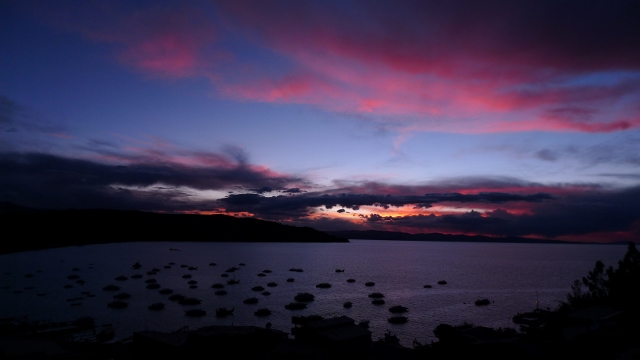
Sunset from our new home: Las Olas Hostel, the best place on Earth.

The night couldn't have been any better. Kitties?! Yes, two adorable little kitties that crawled into my lap.

Day two in Copacabana: Yes, this might not be very tasteful, but I was taking a photo
of the bus, I swear. That kid just happened to be taking a leak at the same time.

They love their trucha (trout) here. You can pretty much order it at any restaurant in town.
You can't really tell from these photos, but Copacabana has a real hippie vibe. Basically, if you're not Bolivian, you're a hippie here. Monica and I stick out for sure. (We're hippies at heart, but just don't display it with dreads and jangles and baggy pants. But who knows what we'll look like five months from now...) It also helps that the Bolivian flag's colors are the traditional rasta green, yellow and red.

Speaks for itself. Totally made my day...

Women selling things on the street. Their clothing style is basically the same as in Peru,
except they are ever so slightly more modern than in Peru.

Right as we noticed this doll for sale on the street corner and Monica picked it up, I saw a woman smiling and sort of sneering as she walked by. Upon closer analysis, we realized this doll was a miniature version of the woman! It's hard to see, but the woman is dead center in this photo. I got my camera out as quick as I could to try to get them both in the photo, but I was a little slow on the draw.

Just a baby leg in the middle of the street, amongst a bunch of other trash.

This homeowner couldn't get his hands on barbed wire.

And finally, back to our little respite at Las Olas.

Las Olas is seriously one of the coolest places I've ever stayed. Monica and I have our own private mud-brick building, two levels, with hammocks on the top level, two enormous beds, a fireplace, windows overlooking Lake Titikaka, a small kitchenette and our own private outdoor patio with more hammocks and nooks to hang out in. We lucked out because the owner couldn't find my original reservation upon arrival, so he let us stay in the suite that's being repainted. Because of the inconvenience, he gave us a discount for the three nights we'll be here, which averages $15/night each. He also owns an amazing restaurant down the way, where we've had dinner and breakfast. He is an artist and designed everything himself, so we keep noticing little details here and there, and we're just amazed by it all. We have one more night here ... I don't want to leave!

Inca Trail


It’s Tuesday, November 29, 8:25pm and I’m lying in my tent, inside my sleeping bag, wearing my headlamp on my head and writing this as it pours outside. There are thunders and lightnights every ten minutes or so. Tonight we are sleeping in the Pacamayo valley, situated at 3600m altitude in the Andes. It’s really cold in the tent, and I’m wearing all my clothes on top of each other, inside the sleeping bag. 


Today we climbed 12 kilometers, gaining 1200 meters in elevation from the previous night, to the highest pass of the trail at 4200 meters. Then we descended to 3600 meters, where we are camping now. It was the hardest day of the hike and by all means one of the most strenuous things I’ve ever done in my life so far. 
Dead Woman's Pass, 4200 meters.
Made it up in one piece. It was all downhill from there, literally.
Anne and I at the top
Group photo at the top.
How the Inca Trail Hike Works
The Inca Trail is a 43km hike over the course of 4 days that ends at Machu Picchu. I would call it a difficult hike, unless you’re in excellent physical condition. There is an option to hire porters to carry your personal belongings, but Anne and I (and most of the people in our group) carried our own gear, which made it a bit harder. The hike is particularly difficult due to the long and steep uphill sections (hours upon hours of climbing thousands of rock steps) and the lack of oxygen in the air at this high elevation. That aside, it’s totally worth it, especially if you’re into backpacking and outdoorsy stuff. 

This hike is now heavily regulated by the Peruvian government, it can only be done through a trekking agency and only by a maximum of ~200 hikers per day (not including porters). Because of that, spots fill up fast and you have to make your reservation months in advance. 

There are about 4 agencies that organize this trek and the cost is around 500USD. The fee includes trail permit, entrance fee for Machu Picchu, bus and train to get back to Cuzco, camping gear, food, guide and wages for all the porters that carry all this stuff. The company we chose is called Peru Treks, mostly because it was highly recommended by one of my coworkers and we also heard it pays porters a fair wage. And let me tell you, these guys have the hardest jobs ever. I’ll talk more about them later. 


Stranded Paranoia
Last night something interesting happened that I’d like to talk about. In hindsight, it all seems so stupid now, but at the time it felt like my worst nightmare come true. After I finished writing down some trip thoughts, I lay down to sleep in our tent. Anne was already asleep next to me. I closed my eyes and realized I wasn’t tired at all, so I just lay there, focusing on my breath and waiting to fall asleep. I then noticed that I was having a hard time breathing (which is likely to happen at this altitude, especially at night time.) I felt as if I was starting to get a case of severe altitude sickness. Which didn’t make any sense, since we’d been in Cusco 4 nights before starting the trek, and had no problems with the altitude whatsoever. I then started panicking, feeling nauseous, out of breath, my heart was racing and it all got completely out of control. All this in the middle of the night, in a campsite, in the middle of the mountains in Peru, far away from any form of civilization, with everyone else in the surrounding tents already asleep. The whole thing turned into a full-blown panic attack, the second one in my life after over 4 years since the first one, when I ended up in the ER in San Francisco. 

I shook Anne multiple times to wake her up, as I was afraid I would pass out. We went outside trying to find the tent where our guide was sleeping. We woke up the poor guy and got an oxygen tank from him.

The oxygen tank didn’t really help, as the real problem was not altitude sickness, but my stupid and completely unexpected anxiety attack. I feared the worst, being stranded in the middle of nowhere with no access to medical care, not being able to continue the hike and all these fears snowballed into that ugly episode.
Anne was a total champ, stayed up with me during this entire moment and encouraged me with positive and logical statements. We ended up chatting for over an hour about all sorts of things that took my mind away from worrisome thoughts, until I passed out. The next day I was totally fine and ready to continue the hike. Saul, our guide, also known with the nickname “Coca Man” came to check on me in the morning and when I told him my story, he said: “This place has a lot of energy. The Incas call it the Sacred Valley.” 


The Porters
The whole porter situation is bugging me a lot, so I’m dedicating a whole chapter to them, these unsung heroes of the Inca trail. The porters are poor, weathered men who carry really heavy loads (25kg) on their backs, wear rubber sandals made of old car tires, and look a lot older than their real age. They live in the villages nearby and are hired by the trekking companies to haul food, tents, cooking gear, gas tanks, etc. on their backs up the Inca trail. While trekkers go up on this trail with their fancy expensive hiking boots, Goretex gear and small backpacks, the porters fly past them with huge loads, often not properly or ergonomically strapped on their backs. They wear open toe sandals. Their feel and toenails are rugged. They never smile. 

Porters at the beginning of the trail getting their cargo weighed, so it doesn't go over the legal allowed weight.
Today on the trail a porter approached me when there was nobody around (I assume they’re not allowed to hassle trekkers) and asked if I had a bit of chocolate. He said he was very hungry. We still had a long ways to go until campsite. I gave him two of my fancy, overpriced San Francisco energy bars and told him they’re not that tasty, but they’ll give him some extra energy. He thanked me several times and gulped them down in a hurry. After he took off, I almost cried. 

Porters drinking chicha (a traditional Peruvian drink made of fermented corn) inside the house of a peasant living on the side of the Inca Trail.
The porters carry our tents, our food, dishes, gas to cook the food, tables and chairs for the big communal eating tent (which doubles as their sleeping tent.) While it’s nice to have a warm meal at the end of 8 hours of climbing, I HATE the fact that my comfort is obtained by these people exerting so much physical effort for so little money. I know it’s their job, and that my 1st world class tourist money makes it possible for them to earn a living, yet there is something about it that deeply bothers me.
On ruins, stray dogs and guinea pigs


"Some experiences simply do not translate. You have to go to know." - Kobi Yamada
 
Saturday, November 26. Today we walked up to an Inca ruin located right above Cusco, at 3700m. Cusco is at 3300m. The ruin is called Sacsayhuaman (and that's a link to Wikipedia, if you want to know more about it.)
View of Cusco from the Sacsayhuaman ruins vista point.
They charged us 70 Soles for a “boleto turistico," which was valid for only one day. This would be $25, a ridiculously overpriced fee for what it is. And of course, as everything else in touristy areas of Peru, there is always a different price for tourists than for locals. The price for tourists is always double or triple of what locals would pay. We know we are getting ripped off, we sometimes try to bargain, but even if we manage to bring the price down a bit, we invariably lose. It will always be way more than the locals pay. But sometimes it’s ok, because these people are so poor that a few dollars for us make a lot of difference to them. 
When we were about to leave the Sacsayhuaman ruins, this cute Quechua grandma and her alpaca were on the side of the road and we couldn't resist the temptation to take photos with them.
The “sexy woman” ruins were ok, not too impressive. Layers of terraces made with meticulously carved stones. If there’s anything memorable about Inca constructions, it would be the stone walls. The way these huge blocks of stone are so perfectly carved and fitted is mind-blowing to me. I don’t believe in aliens, but seeing these structures makes me think of super-human forces. 

Being whiter-skinned and taller than most women here, we can’t escape being singled out as “gringas” everywhere we go. So, while we were visiting these ruins, a group of school children of about 10 years old of age saw us and asked to be photographed with us. What we thought was going to be one photo turned into a 30-minute long photoshoot. Every kid in the group wanted to be photographed with us. Even the moms accompanying the group wanted their own photos. The teacher diligently took all the photos with the same camera and thanked us countless times at the end. A girl started crying, we assumed it was because she was filled with emotion that we hugged her while we were taking photos. Just when we thought we were done with our moment of being in the spotlight, a group of local teenagers approached us and asked if they could take photos with us as well… 

Stray Dogs
Peru must win the record for number of stray dogs. But then again, I haven’t been to India yet. I thought Bucharest was high up there, with about 60,000 stray dogs, but Peru definitely trumps that number. If there’s one thing that terrifies me about walking around on the streets here in Peru are the hoards of stray dogs. They seem to be peaceful  and even little kids walk carefree around them, but I can’t get past the fear that one of them will attack me. Many of them wear a blue collar, which means they were vaccinated by a non-profit, so I take it that Rabies is not an issue in Peru. Some of the stray dogs seem to be nice breeds, like cocker-spaniels, and I’ve been told that they are not all stray, but that their owners leave them loose, pretty much like all other animals around here.  It is not unusual to see chicken, piglets, ducklings, donkeys, cows, sheep, etc. walk around freely on the side of the road. Somehow, all these animals know where their home and who their owner is. It reminds me a lot of the cows in my grandparents’ village, that would come home from the pasture in the evening and stop in  front of the gate of their owner, mooing and waiting patiently to be let in. 

Visiting Tipon and eating Cui
Sunday, Nov 26 – we decided to go see the Tipon ruins, located about 30km outside Cusco. A British girl we met at the hostel told us about these ruins and how to get there. There’s obviously guided tours for everything, but they are always very expensive, so we decided to do it on our own for a lot cheaper. We first took a cab from our hostel to an intersection where we could catch a “collectivo” towards that direction. The cab was 3 soles (about 1 USD). Then, we took a collectivo, which is a minivan filled to the brim with people. Local men and women are sitting anywhere they can. A woman was sitting with half her ass on the stick-shift area near the driver. Kids sleeping on people’s laps, other people standing in the isle, a warm sweaty ooze in the air, but not too bad. We had to stand the entire 40 minute ride, but for 1.2 soles (40 cents) a person, you can’t complain. 
Tipón, located east of Cusco, are Inca ruins that may have been a park for upper class or agricultural centrum. Still today, water is rushing though the channels, which is seldom, and the wide terraces, masterpieces of mortar-less walls, are in perfect condition. (from Wikipedia)
Once we got to Tipon, we had to find transportation to the ruins themselves, as they are perched up a steep hill, 8km away from the village. A guy with a car asked 15 soles to take us there, which is a lot of money, so we said no. No local in the right mind would ever pay that. We ended up sharing a cab with a Peruvian family. The cab contained the following people: driver and visiting Peruvian grandma in the front seats, Peruvian husband and wife, Monica and Anne on the back seat, young Peruvian couple in the trunk. So cabbie and 7 passengers drove up a steep, windy and unpaved road. For this, we paid 3 soles (1usd).
The Tipon ruins were absolutely amazing and totally worth the effort to get there.


The ancient Inca irrigation system at Tipon is still working even today. You can also see the steps made of over-sized pieces of rock, used to move from one terrace to another.
The amazingly perfect carved stones that make up the Inca irrigation system at Tipon.
Towards the end of our visit it started to rain and we couldn’t find any cars to take us back down to the village. We ran into a few other gringo kids in the same situation as us and we decided to hike back together. We were 8 total: a guy from Austria, 3 girls from Holland, one girl from Berkeley and the two of us. The girl from Berkeley was Japanese, one of the two Dutch girls was of Carribean descent. I love how you get to meet diverse and interesting people when travelling.
Our little group decided to take a different path down the hill than the main road, which ended up being an enjoyable 1h hike.
Once back in the village, we all got cui at the local restaurant. Restaurant is too big of a word to describe the dirty little hole in the wall on the side of the road. It was overpriced (we were charged “tourist” price, of course) and kind of disgusting. Cui means guinea pig and it’s a specialty and delicacy for this area.
They either roast or deep-fry the entire animal, including feet, claws, head, teeth, eyes, internal organs.
Needless to say, these little guys don’t have much meat on them, we were hungry still and disappointed at the end of the meal. Between Anne and I, one fluffy and cute little guinea pig would have been better alive than on our plates. At that moment, I really contemplated becoming a vegetarian. We both decided this was going to be our first and last time we tried guinea pig, same as with Inca Cola, the national Peruvian fuzzy drink that looks like pee and tastes like bubble gum. Two Peruvian staples that unfortunately didn’t resonate well with our Western palates.

Tuesday, December 6, 2011

Titikaka and Island Life

Here are a few more photos, catching up from the Inka Trail.

One night in Aguas Calientes after the hike. This was the view from our swanky hotel room, which we got for free through Airtreks travel agency. Holler!

This exceeded our expectations one million times over. The hotel (El Mapi) also gave us a free pisco sour upon arrival, free dinner and free breakfast buffet! We couldn't have asked for any better.

The Inka king statue in the Plaza de Armas in Aguas Calientes (each city seems to have its own Plaza de Armas).
 He looks like a bird trainer with those pigeon friends of his.

On the road again, headed to Puno on the second floor of the bus.
We got the best seats in the house, panoramic view, front seat.

In the middle of nowhere.

Sunset in Puno.

On a boat on Lake Titikaka.

Uros, a collection of 44 manmade floating islands in Lake Titikaka. They've been inhabited for thousands of years.

Boats made out of the dried natural grasses in the lake. These were built for tourists, but they are
simply fancier versions of the traditional boats they use for transportation here.

The grass is used for everything, even a nice cool snack.

Inside one of the huts (built with the grass). There were clothes piled everywhere,
but they seem to be doing okay. That radio was playing...

They of course tried to sell us their handicrafts. It gets very old after a while, as you can't buy something
from everyone and you start to feel bad. Even the children are salespeople.

Floating on the island. Bench made out of grass...

On top of the tourist boat, which Monica and I didn't go on.

We stayed overnight on an island called Amantani. We roomed with a very nice English woman. There were tons of flies, but otherwise quite comfortable. The mattress was made of the grass. The family was quite poor and only gets running water on Tuesdays. They have solar panels for electricity though, which they use to light a couple lightbulbs.

Sheep owned by our hosting family.

A chick on the loose.

Fried cheese and potatoes lunch made for us by our host family. They eat tons of potatoes.

Muna (there should be a tilde over the "n" but I can't figure it out right now). A delicious plant they use as an herbal tea. It tastes a lot like mint and it settles your stomach.

Monica explaining what tres is. The little girl said she was tres (years old), but she held up four fingers.

View from the top of the island we were on.

Sunset was so peaceful here.

Look closely at the way they constructed that arch.

Leaving Amantani for our third island, Taquile (not tequila!).

Our new friend and roommate, Lulu, and a pup from the island.

The small market on Taquile.

Monica bought these traditional Peruvian sandals for herself. They are made out of recycled rubber from tires.
Size four was a big as they come; Monica's foot barely fits in it. Speaking of the size difference, Monica and I are tired of hitting our heads everywhere we go...

Here it is traditional for boys and men to knit along with the women. It is customary that when a man wants to marry, he must pass a knitting test. He knits a hat (as tightly woven as he can), and it has to be able to hold water without dripping any before he can wed. This boy is already practicing.

That's Monica with the shirt over her head, walking alongside our guide. The sun is so intense here (because of the elevation) that it's easy to get sunburned and also heatstroke. Everyone in Peru wears a hat (or some sort of head covering), but surprisingly, never sunglasses.

Monica with three buddies in the history museum in Puno.

Okay, only one of us can be online at a time, and Monica is ready to make a blog post. We are in Copacabana, Bolivia, now and we have much more left to update... I'll save that for a future post.